
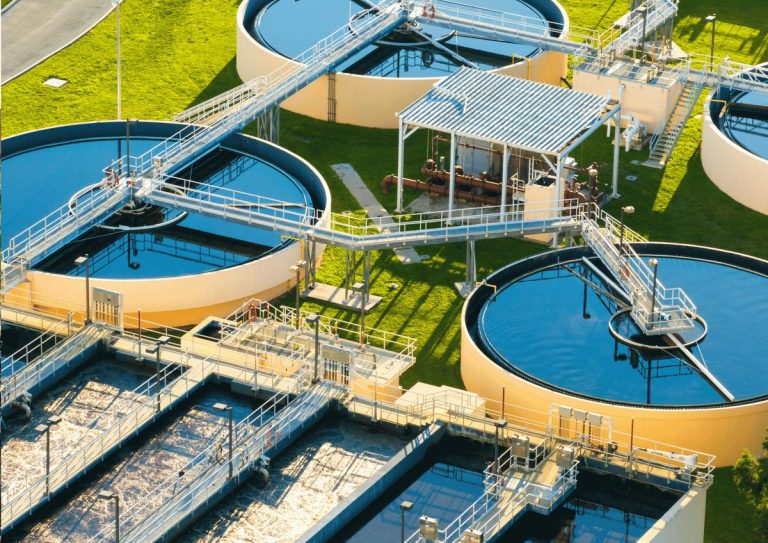
An industrial sewage treatment plant is a system engineered to treat the high-strength, contaminant-heavy wastewater produced by mining and manufacturing operations, bringing it to a standard suitable for safe discharge or on-site reuse. For South African operations, it is the infrastructure that stands between a production process and a Department of Water and Sanitation compliance penalty.
Mining and manufacturing effluent is not domestic sewage. It carries heavy metals and hydrocarbons, alongside chemical residues and organic loads at concentrations that municipal systems are neither designed nor permitted to accept. Treating it correctly on site is both a legal obligation and, increasingly, a financial advantage as municipal water and discharge costs rise.
This guide covers the available treatment plant types and the contaminants they handle. It looks at the industries that depend on them, then closes with a South African mining installation that demonstrates the approach in practice.
What an Industrial Sewage Treatment Plant Does
Industrial wastewater treatment removes contaminants through a sequence of physical and biological processes, with chemical treatment applied where the effluent profile requires it. The objective is consistent: produce an effluent that meets DWA General Standards for discharge, or a reuse-quality output that reduces the operation’s draw on municipal supply.
SewTreat’s industrial water treatment systems are designed around the specific effluent profile of each site, rather than a one-size template. The treatment train for a chrome mine differs from the train for a food processing plant, even where both fall under the same broad industrial category.
The Three Stages of an Industrial Sewage Treatment Plant
Most industrial treatment plants apply three sequential stages, with the level of treatment determined by the effluent profile and the intended end use of the water.
1. Primary treatment removes coarse solids and grit through screening and sedimentation. Chemical dosing assists the separation of heavy particles and oils.
2. Secondary treatment uses biological processes to break down dissolved organic matter. Micro-organisms digest the organic load, reducing COD and BOD to within compliance limits.
3. Tertiary treatment polishes the effluent to its final quality standard through filtration and disinfection. Membrane filtration and UV treatment bring the water to reuse or discharge specification.
For operations requiring potable-quality output or zero-liquid-discharge compliance, additional stages such as reverse osmosis are added to the train. The process schematic on SewTreat’s site shows how these stages connect.
Types of Industrial Treatment Plant
Industrial operations select a plant type based on flow volume and site constraints, weighed against the contamination profile of the effluent. SewTreat manufactures several formats:
- Steel tank biological plants for large-scale mining and manufacturing applications, handling 50,000 to 5,000,000 litres per day with a 20 to 30 year lifespan
- Containerised plants for remote sites and rapid deployment, common on mining camps and construction sites
- Effluent treatment plants (ETP), or Common Effluent Treatment Plant (CETP), configured for specific industrial contaminant streams such as abattoir or washbay effluent
- Underground and plastic tank plants for smaller commercial and access-constrained installations
An Effluent Treatment Plant (ETP) serves a single site, treating the wastewater produced by one operation. A Common Effluent Treatment Plant (CETP) is a shared facility that treats the combined effluent from several operations in an industrial cluster or estate.
For high-volume mining and manufacturing, the steel tank format is the most cost-effective choice. SewTreat’s steel tank biological plants install roughly 50% faster than concrete civil alternatives, with local civil subcontracting that reduces the imported cost component.
Contaminants in Industrial Wastewater
The contaminant profile determines the entire treatment design. The main categories found in South African industrial effluent are:
- Heavy metals such as chrome, copper and zinc from mining and metalworking, requiring chemical precipitation for removal
- Hydrocarbons from plant machinery and vehicle activity, removed through dissolved air flotation and oil-water separation
- High COD and BOD from food processing and beverage manufacturing, reduced through biological treatment
- Suspended solids from mining and processing, settled out in primary treatment
- Chemical residues such as acids and caustics from manufacturing, neutralised before they reach the biological stage
Each contaminant category calls for a specific treatment response. A plant designed to remove iron and manganese will not address dissolved chrome, which is why effluent analysis precedes any system specification. For complex chemical streams, SewTreat applies pre-treatment through membrane filtration and chemical dosing before the biological stage.
Industries That Depend on Industrial Treatment Plants
Mining
Mining produces effluent loaded with heavy metals and hydrocarbons, carrying suspended solids governed by some of the strictest discharge conditions in South African environmental law. Chrome, platinum and copper operations each carry distinct contaminant profiles written directly into their Water Use Licence conditions.
Manufacturing
Manufacturing plants generate chemical-laden wastewater that requires neutralisation and targeted contaminant removal before discharge. Power plants and refineries add cooling system blowdown and hydrocarbon contamination to the profile.
Food and Beverage Processing
Food processing and abattoir operations produce high organic loads alongside fats and elevated nutrient concentrations. These respond well to biological treatment, with nutrient recovery available as a by-product. SewTreat’s abattoir wastewater systems are built for this profile.
Commercial and Mixed-Use Developments
Hotels and malls treat wastewater on site to reduce municipal water bills and meet sustainability targets, with treated water redirected to irrigation and cooling.
Case Study: Samancor Chrome, Lesedi Mine
Samancor Chrome’s Lesedi Mine near Rustenburg in North West Province needed a wastewater treatment system that could handle mining effluent while scaling with the mine’s expansion plan. A fixed-capacity plant would have meant a costly replacement once production grew.
SewTreat designed and installed a 200,000-litre-per-day steel tank biological treatment plant, with the system architecture built to reach 400,000 litres per day as the operation expands. Rather than requiring a full greenfield build, SewTreat integrated the mine’s existing 120,000-litre sump as a buffer tank to manage peak flow variations from shift changes.
The result is a compliant treatment system matched to current demand, with a defined expansion path that protects the original capital investment. The modular steel tank format made that phased approach possible without decommissioning the first stage. Download the full case studies for verified data across SewTreat’s mining and industrial projects.
Compliance: What South African Operations Must Meet
Industrial wastewater discharge in South Africa is governed by the National Water Act (Act 36 of 1998), administered through the Department of Water and Sanitation. The DWA General Standards set default discharge limits. Site-specific limits, usually more stringent, are written into each operation’s Water Use Licence.
Mining and heavy industrial operations face the most detailed requirements, with effluent quality and discharge volumes specified directly in environmental authorisations. SewTreat’s systems are designed to meet or exceed these standards at the appropriate treatment tier, and include automated monitoring that generates the operational records and documentation required for licensing submissions and regulatory audits.
For operations targeting reduced municipal dependency, treated effluent can be directed to full water reuse across irrigation and cooling, as well as process applications.
Choosing the Right System for Your Operation
The starting point for any industrial treatment decision is an effluent analysis that identifies the contaminant profile, followed by a flow assessment that establishes the required capacity. From there, SewTreat specifies the treatment train and plant format, along with a capital cost estimate.
Use SewTreat’s calculator to estimate the potential savings from on-site treatment and reuse, or contact SewTreat directly to discuss your effluent profile and site requirements.