
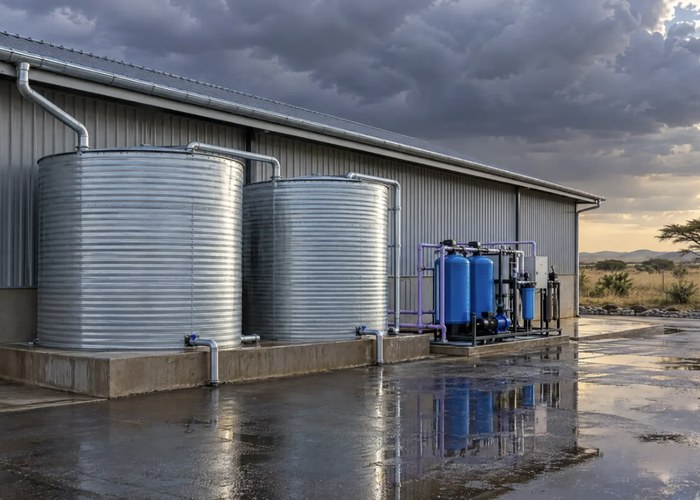
Rainwater harvesting is the practice of capturing rain from a roof and storing it, then treating it to the standard its end use requires. For a commercial site with a large roof, it is one of the few water sources that costs nothing at the point of supply.
The catch is timing. In August the South African Weather Service reported that Cape Town International Airport recorded only 14.4 mm in July, about 16% of its average and the lowest July total there since 1958. Rain in this country arrives in seasons, and a system that works is one designed around the months when it does not fall.
Where the Rain Falls, and When
Most of South Africa is a summer rainfall area, with the bulk of its rain arriving between November and March. Over the interior plateau, much of it falls as thunderstorms. The south-western Cape works the other way round, receiving most of its rain from cold fronts between May and August, while the Western Cape’s southern coast gets rain throughout the year.
Totals vary as much as timing does. More than 60% of the country receives under 600 mm a year, and rainfall generally rises from west to east. A roof in KwaZulu-Natal and an identical roof in the Northern Cape will not produce anything like the same volume.
That is why no two systems should be sized from the same template. Every design starts from the roof area and the local rainfall pattern, measured against the demand the water must meet.
How a Rainwater Harvesting System Works
Every rainwater harvesting system, from a single house tank to a logistics park, follows the same sequence. Rain lands on the roof and runs into gutters and downpipes. It passes through pre-filtration that stops leaves and grit before they reach storage, then sits in a tank until it is needed.
On a commercial site, the water is then pumped through treatment and into the facility’s reticulation. SewTreat’s typical design runs the water through filter media and granular activated carbon, then disinfects it before it goes to irrigation or process lines.
A plastic tank under a downpipe is a rainwater collection system, and it serves a garden well. Treatment is what decides how far into a building the water can go.
Working Out What Your Roof Can Yield
The arithmetic starts with one conversion. One millimetre of rain falling on one square metre of roof is one litre of water. Multiply the roof’s plan area by the annual rainfall in millimetres and you have the theoretical maximum in litres.
Real roofs deliver less than that. Some rain evaporates or splashes clear, and the first dirty flush is best diverted away from storage. Roofing material matters too: the City of Cape Town notes that 11 mm of rain on 100 m² of metal roof can produce 1 000 litres, while a tiled roof needs 16 mm to deliver the same volume.
Take a hypothetical warehouse with 5 000 m² of metal roof on a site that averages 600 mm a year. The theoretical figure is 3 million litres. Applied to the metal-roof ratio above, a realistic annual harvest sits closer to 2.7 million litres.
That volume does not arrive evenly. In a summer rainfall area most of it falls within five months. Storage has to carry the site through the rest.
Sizing Storage Around the Dry Months
Getting storage right is a balancing exercise. A tank that fills in the first big storm and overflows for the rest of the season wastes most of what the roof could collect. A tank sized for the entire annual harvest may never fill at all.
The practical approach is to size against demand. Start with the daily volume the rainwater will replace. Then decide how many dry weeks the tank should carry that demand before municipal supply takes over again.
SewTreat builds harvest storage in Zincalume steel or concrete, from 15 KL up to 3 ML, above or below ground. A harvest tank can also be paired with municipal top-up, so the site draws rainwater first and switches over automatically when the level drops. The same failover logic runs through SewTreat’s backup storage systems, which move a facility onto stored water when municipal pressure falls.
Size can also trigger paperwork. In Cape Town, any single tank over 10 000 litres needs building plan approval, as does any tank raised more than 1 m on a supporting structure.
Treatment Depends on Where the Water Goes
Rainwater starts cleaner than most alternative sources, but it is not clean. Roofs collect leaves along with bird and rodent droppings, and in cities the rain picks up air pollution on the way down. Stored rainwater tends to be better in the wet months, when fresh rain dilutes what has built up in the tank.
The treatment train follows from the end use. The table below sets out the typical requirement for each use, drawing on the City of Cape Town’s alternative water guidelines and SewTreat’s own process design.
| End use | Typical treatment | Worth knowing |
| Garden and lawn irrigation | Screening and basic filtration | Drip or subsurface delivery keeps contact low, and use may be limited during water restrictions |
| Vehicle and outdoor surface washing | Screening and basic filtration | Filtered rainwater may be used untreated for this in Cape Town |
| Toilet flushing | Filtration at minimum, with disinfection lowering the risk | Plumbing it indoors requires backflow protection on the municipal line |
| Laundry and indoor surface cleaning | Filtration and disinfection after a laboratory test | Treated rainwater only, with municipal approval for the plumbing |
| Cooling and process water | Filtration and activated carbon, then disinfection | The quality target is set by the equipment it feeds |
| Drinking water and other domestic use | Full treatment to SANS 241 with ongoing testing | Not permitted in Cape Town outside a Water Services Intermediary contract |
Testing comes before any of this. Cape Town’s guidance is to have the water analysed by a SANAS-accredited laboratory, then compare the results against the national water quality guidelines for the intended use.
The Rules: Schedule 1 and Your Municipal By-law
Harvesting rain from a roof is permitted under Schedule 1 of the National Water Act, and rainwater systems do not need a licence from the Department of Water and Sanitation. That is the national position. The obligations that matter day to day sit with your municipality.
Cape Town publishes detailed requirements, and they give a good sense of what to expect. Any rainwater system plumbed into a building needs City approval. The municipal supply must be protected by a reduced pressure zone (RPZ) backflow preventer, or by a break tank with an air gap of at least twice the supply pipe diameter and never less than 25 mm.
Pipes carrying alternative water are marked in lilac, and signage at the entrance and at each outlet must warn that the water is not for drinking. Overflow from a tank of untreated rainwater goes to stormwater, while overflow from chemically treated rainwater goes to sewer.
Other metros set their own by-laws, so confirm the local position before the design is finalised. Building approval into the design stage avoids reworking pipework later.
What It Looks Like at Scale
SewTreat’s rainwater system at Pick n Pay’s Eastport Logistics Park in Kempton Park shows the approach on a very large roof. Rain from the roof collects in a 3 ML attenuation dam, then passes through filtration and activated carbon before sodium hypochlorite disinfection.
The plant processes up to 300 000 litres a day, and the treated water is held in a 1 ML underground tank that supplies the site’s cooling plant. When rainfall is low, an automatic valve tops the system up from municipal supply, so supply does not depend on the weather alone.
The rainwater system is worth more than R2.5 million a year in savings and paid for itself in 22 months. The full case study also covers the truck washbay recycling plant that runs alongside it.
FAQs
Is it legal to collect rainwater in South Africa?
Yes. Harvesting rainwater from a roof is permitted under Schedule 1 of the National Water Act and needs no licence from the Department of Water and Sanitation. Plumbing it into a building still needs municipal approval in cities such as Cape Town.
Is rainwater safe to drink?
Not without treatment and testing. Untreated rainwater can carry contamination from droppings on the roof, and drinking water in South Africa is measured against SANS 241. In Cape Town, the Water By-law does not allow alternative water to be used for drinking, even when treated, outside a Water Services Intermediary contract.
How much rainwater can a roof collect?
A metal roof delivers roughly 0.9 litres for every millimetre of rain on each square metre. A tiled roof delivers closer to 0.6 litres for the same rainfall.
What are the disadvantages of rainwater harvesting?
Supply follows the seasons, so a system can run low in exactly the months water is scarcest. Storage takes space and capital, and quality varies with the roof and its surroundings. Good design narrows these gaps without removing them.
Planning a Rainwater System for Your Site
Roof area and local rainfall set the ceiling on what a site can harvest. Demand and storage decide how much of it you actually use, and the end use decides the treatment.
Once a system is running, filters and disinfection need regular attention, and Cape Town’s by-law requires every storage tank to be drained for inspection at least once every five years, with disinfection before it returns to service. SewTreat’s maintenance team can take that on.
SewTreat designs rainwater harvesting systems from catchment through to commissioning. The savings calculator gives a first estimate of what moving part of your demand off municipal supply could be worth.