
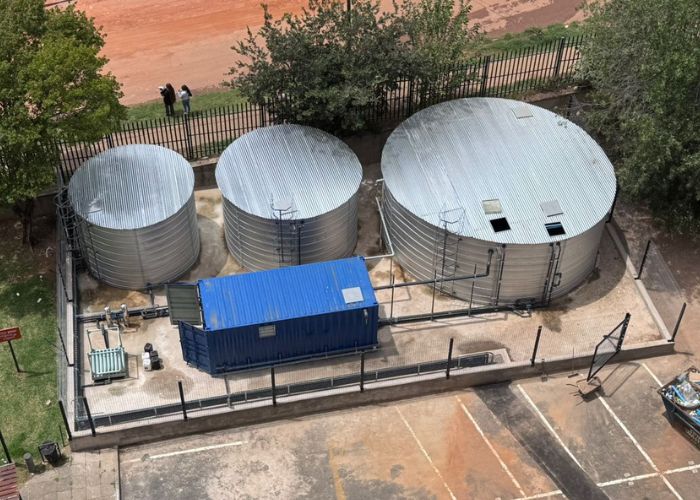
South Africa faces a critical water infrastructure crisis that threatens business continuity across all sectors. With 64% of wastewater treatment plants classified as high risk and a projected 17% water deficit by 2030, businesses cannot afford to rely solely on failing municipal systems. SewTreat has delivered over 250 water and wastewater treatment solutions across 15 African countries since 2016, helping businesses achieve water independence with proven cost savings averaging R1.5 million to R4.7 million annually per installation.
Why South Africa’s Water Crisis Can’t Be Ignored
South Africa is one of the 30 driest countries globally, receiving only 464mm of rainfall per year which is less than half the global average. The country’s water crisis extends beyond scarcity. According to the Department of Water and Sanitation’s 2023 Drop Reports, only 3% of water systems (26 out of 958) achieved Blue Drop certification for quality, while 56% of treatment plants operate in poor or critical condition. Municipal infrastructure loses 47% of treated water through leaks, theft, and aging systems, well above international norms.
For businesses, this crisis creates operational risk, escalating costs, and compliance challenges. SewTreat specialises in providing advanced water and wastewater treatment services that enable businesses to operate independently of failing municipal infrastructure while achieving significant cost savings and environmental sustainability goals.
The Challenges of Water Treatment in South Africa
South African businesses face multiple water-related threats:
Infrastructure Failure: With 98% of water resources already allocated and 64% of wastewater treatment plants classified as high risk, municipal systems cannot meet growing demand.
Non-Compliance Risk: Only 26 out of 958 municipal water systems meet quality standards. Businesses discharging wastewater face stringent regulatory requirements with minimal municipal support for compliance.
Cost Escalation: South Africans consume 234 liters per person daily—35% above the global average of 173 liters—driving up costs. Municipal water debt has reached R22.36 billion, threatening tariff increases and service reliability.
Climate Volatility: February 2024 was the driest February in 40 years across southern Africa, demonstrating the region’s increasing vulnerability to climate-driven water scarcity.
SewTreat addresses these challenges through modular, containerized, and custom-designed systems that maximize treatment efficiency while minimizing operational costs and environmental impact.
SewTreat’s Innovative Solutions
SewTreat delivers industrial-grade water treatment solutions including Ultrafiltration (UF), Reverse Osmosis (RO), Integrated Fixed Film Activated Sludge (IFAS) processes, and Moving Bed Biofilm Reactor (MBBR) systems. These technologies enable businesses to:
- Treat and reuse wastewater for toilet flushing, irrigation, cooling towers, dust suppression, and washbays
- Achieve regulatory compliance with consistent water quality
- Reduce municipal water dependency by 50-100%
- Process high-contamination effluent with Chemical Oxygen Demand (COD levels) exceeding 3,000 mg/L
The company’s modular approach allows rapid deployment—demonstrated by the Beira Brewery project in Mozambique, where a complete 30,000-liter-per-day (KLPD) containerized wastewater treatment plant was designed, manufactured, and commissioned in just two months.
Proven Results: Case Studies of Success
SewTreat’s track record across 250+ projects demonstrates measurable business impact:
Pick n Pay Eastport Logistics (Johannesburg): A 500 KLPD integrated system comprising two plants working in tandem delivers R4.7 million in annual savings. The 200 KLPD truck washbay treatment plant produces enough treated water to take the washbay completely off-grid, with zero top-up required from council. A separate 300 KLPD rainwater harvesting plant — fed by a 3-million-litre dam and 1-million-litre underground storage — reduces council demand for cooling towers and site operations by 80%.
University of Johannesburg: A greywater treatment plant designed for 67 KLPD and serving two student residences currently produces 30–40 KLPD of treated water for toilet flushing and sports field irrigation — reducing potable water consumption from council by approximately 55% and generating R1.5 million in annual savings.
Eastland’s Mature Living Estate (Benoni): After a competitor’s plant failed to meet Department of Water Affairs discharge standards, SewTreat retrofitted a 120 KLPD underground fiberglass system that brought the estate into full regulatory compliance. The solution also delivers R2.07 million in annual savings — demonstrating that compliance and commercial value are not mutually exclusive.
Kamoa Copper Mine (DRC): Three steel tank wastewater treatment plants with combined capacity of 1,500 KLPD (850 + 300 + 350 KLPD) handle the unique challenges of copper mine effluent, including elevated solids, hydrocarbons, and fine copper particulates. The IFAS process reduces sludge production while treating water for irrigation, toilet flushing, and dust suppression in a remote location without municipal services.
KG Mall (Witbank): An 80 KLPD system upscaled to 140 KLPD equivalent capacity handles shopping centre effluent with fats, oils, and greases up to 800 mg/L. Extended retention times (4.7 days versus the standard 2.5 days) ensure effective digestion of high-contamination wastewater for reuse in cooling towers, irrigation, and toilet flushing.
Sustainability and Minimal Maintenance
SewTreat systems are engineered for long-term reliability in African conditions. Steel tank systems feature corrosion-resistant coatings, while containerized units provide plug-and-play deployment in remote locations. The IFAS and MBBR technologies minimise sludge production, reducing waste disposal costs and environmental impact.
Energy-efficient designs lower operational costs, while modular construction enables staged expansion as business needs grow. All systems are designed to meet or exceed Department of Water Affairs discharge standards, protecting businesses from compliance risk while enabling water reuse to conserve resources.
Why Choose SewTreat
SewTreat differentiates itself through:
Proven Track Record: 250+ projects completed across 15 African countries since 2016, serving industries from mining and retail to universities and residential estates.
Measurable ROI: Documented annual savings ranging from R1.5 million to R4.7 million per installation, with rapid payback periods through reduced municipal water consumption and wastewater discharge fees.
Technical Expertise: Advanced treatment technologies (UF, RO, IFAS, MBBR) capable of handling complex effluent challenges including high COD loads, fats/oils/greases, and variable peak flows.
Rapid Deployment: Complete systems designed, manufactured, and commissioned in as little as five weeks for urgent requirements.
Turnkey Solutions: Full scope including design, civil works, plumbing retrofits, installation, commissioning, and ongoing operations and maintenance support.
Regulatory Compliance: All systems engineered to meet stringent Department of Water Affairs standards, protecting businesses from environmental liability.
Whether you require sanitation systems for residential estates, effluent treatment for industrial facilities, or water reuse solutions for commercial properties, SewTreat’s custom-designed approach delivers reliable performance with rapid ROI.Take the next step in securing your water treatment needs. Contact SewTreat to discuss how we can deliver measurable water savings and regulatory compliance for your business.