
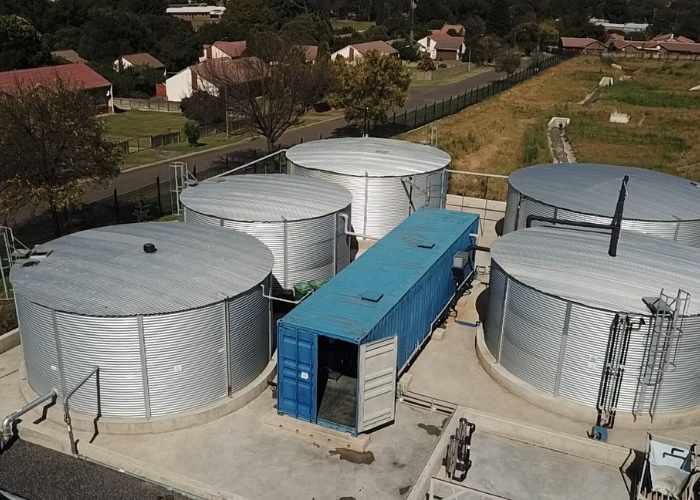
For large-scale applications, SewTreat’s Steel Tank Biological Wastewater Treatment Plant is the most cost-effective solution in the market. Backed by 80+ years of expertise across Africa, these plants are purpose-built for volume, with a design philosophy centred on longevity and scalability.
Considering that South Africa’s infrastructure is under sustained pressure, with municipal treatment capacity unable to keep pace with industrial growth, large-scale operations are now increasingly required to manage their own waste water. And the question is no longer whether treatment capacity should be invested in, but which system would offer the best return over its working life.
What Is A Steel Tank Biological Wastewater Treatment Plant And Is It The Right Choice At Scale?
A steel tank BWWTP is an above-ground biological treatment system constructed from corrugated steel vessels. Each tank houses a dedicated treatment stage, with all process equipment consolidated in a single control room. The system is manufactured off-site, transported to site in components, and assembled with minimal civil works.
This format solves two problems that concrete civil systems cannot address at scale:
Installation speed at a competitive capital cost.
| Advantage | What It Means |
| 50% faster installation | Operations reach compliance sooner than with comparable civil systems |
| Most cost-effective at scale | Civil construction is subcontracted locally, reducing the imported cost component significantly |
| 20 to 30 year lifespan | An infrastructure investment, not a capital equipment cycle |
| Scalable by design | Additional modules are added as flow demand grows, without decommissioning the existing plant |
| Handles variable loads | Buffer capacity built into the design manages peak inflows without compromising effluent quality |
| Full treatment spectrum | Every stage from inlet screening to final disinfection is covered within the modular tank layout |
SewTreat also offers an ongoing operations and maintenance programme to protect system performance over that full lifespan.
Flow Capacities
SewTreat’s steel tank BWWTPs cover the full range of large-scale treatment requirements:
- Standard flow range: 50,000 litres to 5,000,000 litres per day
- Custom capacity: larger plants are designed on request
- Scalable design: phased expansion from current to projected capacity is built into the system architecture from the start
At Samancor Chrome’s Lesedi Mine near Rustenburg, SewTreat delivered a 200,000-litre-per-day plant engineered to expand to 400,000 litres per day as the mine scales production. The existing site sump was integrated as a buffer tank. No greenfield rebuild will be required when Phase 2 commences.
At Kamoa Copper Mine in the DRC, three steel tank plants were commissioned simultaneously: one at 850,000 litres per day, with the other two at 350,000 and 300,000 litres per day respectively. All three treat copper mining effluent characterised by high solids loading and elevated hydrocarbon content, producing reuse-quality effluent for non-potable site supply.
How the System Works
SewTreat’s steel tank plants use Integrated Fixed Film Activated Sludge (IFAS) technology as the biological treatment core. IFAS combines two processes:
- MBBR (Moving Bed Biofilm Reactor): Plastic carrier media move freely through the aeration tank. Micro-organisms colonise the carriers and break down dissolved organics as wastewater passes through.
- RAS (Return Activated Sludge): Settled sludge from the clarifier is recirculated back into the aeration zone, maintaining the biological population at the concentration needed for consistent COD removal.
Together, these processes produce less sludge than conventional systems and perform reliably through variable loading conditions without requiring access to municipal disposal infrastructure. You can go read more on SewTreat’s website about how their treatment plants work.
Treated effluent across SewTreat’s installed base is directed to non-potable reuse rather than discharged where avoidable. Common end uses include dust suppression on mine sites and irrigation on residential estates, with toilet flushing and cooling tower supply in commercial buildings.
Real-World Applications
Mining Sector
Mining operations generate wastewater with some of the most challenging contamination profiles of any sector. Shift changes produce peak inflow spikes that can double the hourly flow rate, while the base effluent typically carries high solids loading from processing activity alongside hydrocarbon content from plant and vehicle operations.
At Kamoa Copper Mine in the DRC, SewTreat was awarded the contract ahead of 15 competing companies from six countries. The three steel tank plants handle copper processing effluent characterised by fine particulates and variable COD loads driven by fluctuating hydrocarbon content. All treated water is reused on-site.
Commercial Sector
Large commercial facilities produce wastewater dominated by fats, oils, and greases, collectively referred to as FOG, from food tenants. Standard biological retention times are insufficient at elevated FOG concentrations.
At KG Mall in Witbank, incoming FOG reached 800 mg/L with Chemical Oxygen Demand exceeding 3,000 mg/L. SewTreat extended the hydraulic retention time from 2.5 to 4.7 days to manage that load. Treated water now supplies the mall’s cooling infrastructure, with the balance directed to fire water storage and sanitation facilities. See all case studies.
Industrial and Logistics Sector
At Pick n Pay’s Eastport Logistics Park near OR Tambo International Airport, SewTreat designed a 500,000-litre-per-day system that harvests rainwater into a 3-million-litre dam while treating truck washbay wastewater through a dedicated biological plant. The system delivers R4.7 million in annual savings through reduced municipal water dependency.
Facilities carrying industrial effluent profiles, including elevated COD, hydrocarbon loading from washbay operations, or pH-variable waste streams, can address pre-treatment requirements through SewTreat’s industrial water treatment systems before wastewater reaches the biological stage.
Municipal and Residential Sector
At Eastlands Mature Living Estate in Benoni, a competitor’s failed system was retrofitted by SewTreat into a 120,000-litre-per-day underground plant. The estate now saves R2.07 million per year, with treated water reused for irrigation across the development.
Residential estates and municipal developments without sewage infrastructure access represent a growing segment of SewTreat’s project base. The steel tank format’s above-ground modular construction is well suited to constrained suburban sites where a concrete civil build would be disruptive or cost-prohibitive.
Compliance and Water Reuse
All SewTreat steel tank BWWTPs are designed to meet or exceed DWA General Standards for treated wastewater quality. The engineering scope covers process design through to the automated monitoring data generated by the system’s PLC-based controls. Operational records are captured continuously, with full documentation available for Water Use Licence compliance submissions under the National Water Act.
Operations running a borehole water supply alongside a wastewater plant can integrate both through SewTreat’s borehole water treatment systems, creating a complete on-site water cycle within a single managed installation.
Why SewTreat
SewTreat brings 80+ years of water treatment expertise across Africa to every project. That experience covers mining operations in the DRC through to commercial developments in South Africa, with a substantial project base in areas where no municipal infrastructure alternative exists.
The steel tank BWWTP is the product that best represents SewTreat’s core proposition: fast installation at a lower cost per kilolitre treated, backed by a maintenance programme designed to protect the investment over the full 20 to 30 year lifespan.Use SewTreat’s calculator to see what your operation could save, or contact SewTreat directly to discuss your site requirements.